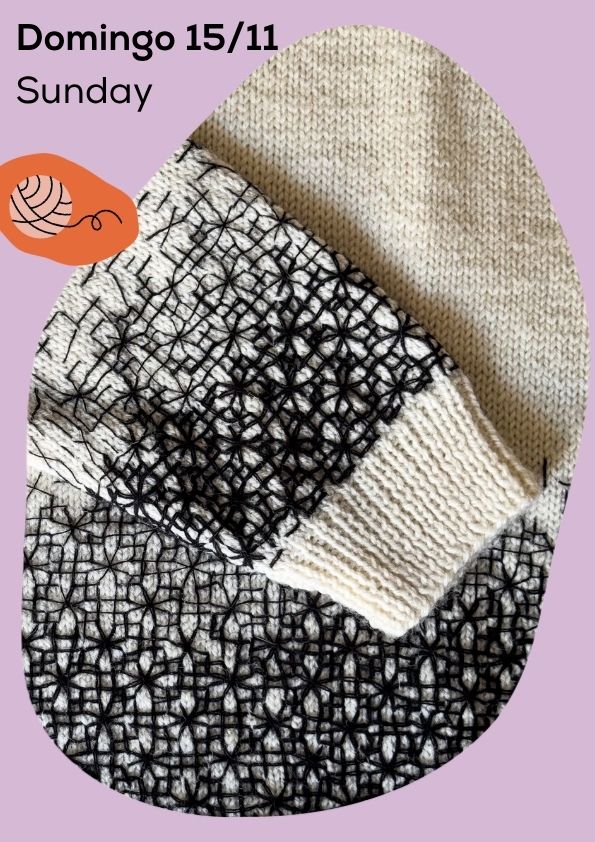
Blackwork embroidery is a fascinating technique traditionally used to fill shapes with geometric patterns. It follows a precise sequence of stitches, which isn’t difficult but is important for achieving a clean, neat reverse side.
On fabric, this technique is usually worked by counting threads to achieve a uniform and symmetrical design. On knitted garments, however, tracing paper makes everything much simpler and more fun. At first it may seem complicated, but it is actually quite similar to cross-stitch. Once you get started, most people find it easy to grasp.
- Language: English
- Date: Sunday, 15/11 from 9 to 12 h
- Technique: Embroidery
- Seats: 20
- Level: Beginners
- Previous knowledge: Be familiar with embroidery techniques and accessories.
- Material necesario:
- Embroidery thread (mouliné) or embroidery wool. This is a great opportunity to use up what you already have in your stash
- The knitted gauge swatch or one of the alternative materials mentioned
- Embroidery needles for wool (sharp point, large eye, suitable for your thread. Do not use blunt-tipped wool needles)
- Embroidery hoop (it must be smaller than the gauge swatch)
- Small scissors
- Fine-tipped black marker pen to mark out the design
- Water-soluble tracing paper (also available as a self-adhesive stabiliser)
- Notepad and pen or pencil for notes
- Homework:
- Before the class, knit a square swatch in stockinette stitch using DK-weight wool.
- The square should measure approximately 20 cm on each side. Make sure you stick to these measurements, as it will need to be placed in an embroidery hoop and must be slightly larger than the circumference of the hoop. We recommend bringing a 22 cm hoop.
- Don’t forget to iron the swatch, as this will make the embroidery process easier.
- Alternative to the swatch:
- If you don’t have time to knit it or would rather not, you can bring an old jersey garment that you no longer wear. It can be hand-knitted or shop-bought, provided it has a smooth surface and fits in the hoop. Make sure the fabric isn’t too thick, so that it’s comfortable to embroider and the result is visible.
- You can also bring a piece of white woven fabric (not knitted), such as linen or cotton, with a firm, even weave. It will be perfect for practising the technique if you don’t want to work directly on knitted fabric.
- Sponsored by: Coruja